Level changes rewrite a garden plan because a sloping garden creates zones, views, and drainage lines that a flat drawing hides. What reads as one open rectangle on paper behaves like three separate rooms the moment you walk it.
That gap between the drawing and the ground is where most budgets come undone. At Peninsula Compost, we see plans that ignore the fall, then need extra soil, drains, and walls to patch the problem later.
Good sloping garden ideas start with the fall, not the wish list. Levels change where water sits, where sun lands and where you can safely stand.
This guide covers how to set your levels, hold the soil, move water, and spend well on a slope. We’ll start with the measurements.
Terraced Gardens Start With Garden Levels You Can Measure

Most sloping garden plans fail because the garden levels get drawn before anyone measures the actual fall. A string line, a spirit level and an afternoon tell you whether you have a gentle slope or a pitch steep enough to need an engineer.
Those readings decide how your terraces get built. Mark the fall at the top, middle, and base of the sloped yard, then write the numbers straight onto the plan.
How Retaining Walls Hold a Height Difference in Place
Retaining walls hold a height difference in place by pushing back against soil that wants to slide downhill, which is why height limits exist. For example, in Victoria, a wall over one metre in height needs a building permit, a threshold set by the Victorian Building Authority.
Because of this, drainage sits behind the wall as well as in front of it. We always specify ag pipe and gravel backfill, since trapped water cracks far more walls than soil weight ever does.
Retaining is the hard landscaping every later decision leans on. A properly built base lets one good wall replace three flimsy ones (your back will thank you in year five).
Garden Steps and Garden Paths That Link Each Terrace
Steps link each terrace, and their rise and tread decide whether anyone bothers using the upper garden. Around 150 mm of rise with a 350 mm tread reads as a stroll rather than a climb.
Wider treads also let you push a full barrow up without stopping halfway, which helps on delivery day. Garden paths follow the same logic, so they should run across the garden slopes instead of straight down them.
Stone steps or timber sleepers both do the job, and matching them to your walls gives you one clean line.
Timber, Brick, Stone or Gabion Walls?
Timber, brick and stone each buy you something different, so the choice follows your budget and how long the wall needs to last. Treated pine sleepers cost the least and hold for roughly 15 years.
Brick and block last closer to 50 years, while natural stone costs the most upfront and drains itself through the joints. Gabion walls, which are wire cages packed with rock, land in the middle on price and drain freely by design.
Many owners use sleepers along the back boundary and save stone for the entry. This can cut the spend significantly and still look good from the footpath.
Planting Sloped Gardens So the Soil Stays Put

Planting well on sloped gardens cuts erosion, holds moisture, and saves you mowing a dangerous bank. Roots bind the top 300 mm into a mat that rain runs over rather than through, so plant selection does structural work here.
Three moves count before you order a single plant. Steep gardens reward planting density more than any clever species list.
Choosing Groundcover Plants That Grip the Bank
Groundcover plants grip a bank when their roots spread sideways, and their foliage closes over bare earth within two seasons. Vinca, creeping boobialla and prostrate grevillea all knit together fast on a dry aspect.
Beyond that, native grasses like lomandra send roots down 600 mm and hold a batter that mulch alone would lose. Four plants per square metre through jute matting carries a hillside garden through its first winter.
Honestly, lawn has no place on anything steeper than one in four, because mowing a bank is genuinely unsafe (ask anyone who has slipped with a catcher on).
Raised Beds and Rock Gardens for Awkward Corners
Raised beds give you flat, workable ground in the leftover corners without a full excavation. A 600 mm bed cut into the high side and built up on the low side creates level growing space for herbs and vegetables.
Rock gardens suit the pockets too tight for beds, where stone holds warmth and sedums cope with the sharp drainage. Gaps between the rocks stay cooler and damper than the surface suggests.
Our compost mixes suit both jobs. Beds on a slope drain quickly and need plenty of humus to hold water.
Why Does Erosion Strip a Steep Hillside So Fast?
Soil erosion strips a steep hillside fast because raindrops hit exposed ground with enough force to knock particles loose, and gravity carries them off. One storm can even shift the top 20 mm of an unplanted batter.
Water also gathers speed over every metre of fall, so a 10 metre run moves far more soil than a 3 metre one. That’s the mechanism behind the rills you see cutting across bare earth after heavy rain.
Bottom line: Mulch to 75 mm and planting straight away breaks both stages of that process in a single weekend.
How Do You Manage Water on a Sloping Backyard?
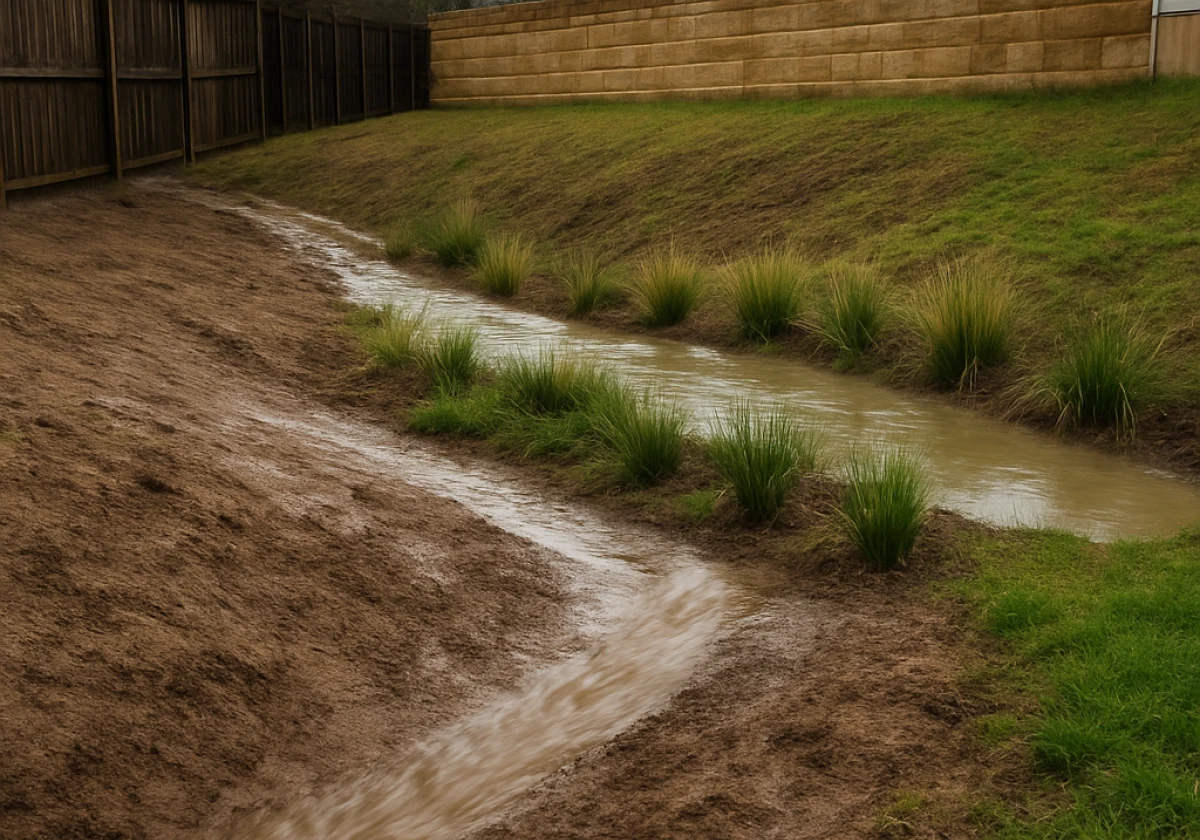
You manage water on a sloping backyard by slowing runoff with terraces, drains, and planting before it reaches the house. Every design choice either holds water in place or hurries it along, and there is no neutral option on a slope.
Work from the top down, because anything built below fails if the flow above it stays untouched. A shallow swale (a wide channel that redirects runoff) cut across the contour and planted with grasses catches the first surge and lets it soak in. A gravel-filled trench does the same job with less charm.
Below that, a spoon drain (a shallow curved concrete drain) at each wall base directs overflow sideways into a rain garden or tank, keeping water away from the block. We’ve seen a single 90 mm ag line fix damp that two pumps couldn’t shift.
Cascading water features suit a sloped backyard, since the fall gives a pond movement for free. Just make sure the overflow ties into your drainage system and not the neighbour’s fence line.
Budget Backyard Landscaping Can Outperform a Full Landscape Design
Quotes for terracing a steep block often run into five figures before a single plant goes in. Staging the work gets you most of the result for a fraction of that.
The table below shows where the money goes:
| Approach | Rough spend | What you get |
|---|---|---|
| DIY sleeper terrace | $120 per metre | Two usable levels, one weekend |
| Compost, mulch and mass planting | $600 total | Erosion control across a full bank |
| Designer plan only | $1,500 | Measured levels you build over years |
| Full landscape design package | $15,000 | Finished outdoor living zones, built |
The middle two rows carry the most value per dollar, because soil and plants fix drainage and erosion at once. Sensible backyard landscaping spends there first, then adds built structures once a wet winter has shown where the water really goes.
Full landscape design earns its keep on complex sites, though rarely before the drainage is sorted. Plenty of sloping garden ideas cost little more than a delivery of compost and a free weekend.
Ready to Put These Sloping Garden Ideas to Work?
Your slope gives you opportunities for distinct zones, wider views and sheltered areas that are harder to create on a flat block. Any site measured first and planted early pays that effort back.
Pick one terrace this season and get soil and groundcovers into it before the rain arrives. Momentum on a sloping site beats a perfect plan that sits in a drawer.
Peninsula Compost supplies compost, soil blends and mulch for terraces, banks and raised beds across the Peninsula. Send your site details and email address to the team for a delivery quote and ground that’s ready to plant.